
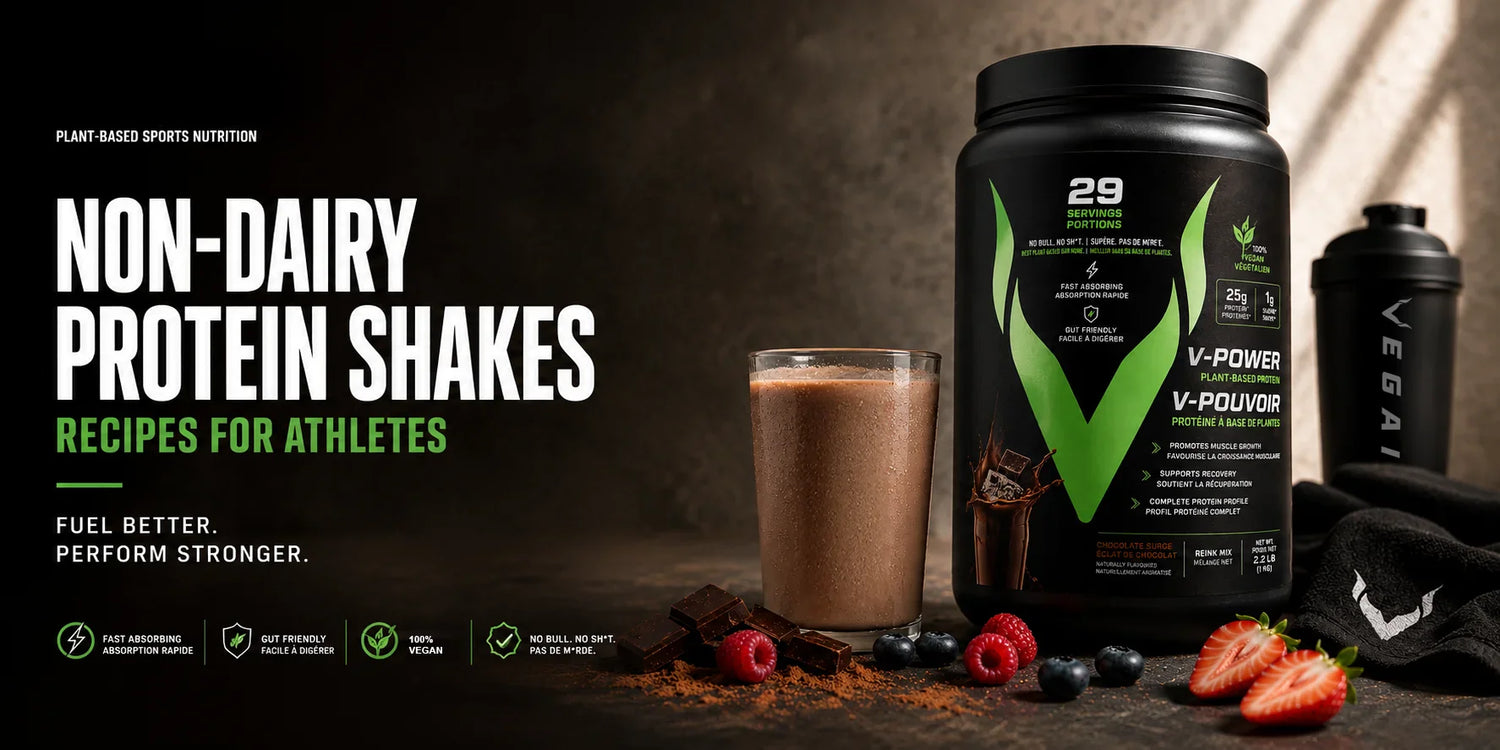
Non-Dairy Protein Shakes Recipes for Athletes
The right non-dairy protein shakes recipes do more than swap out dairy — they change how you perform, recover, and feel across every training session.
Key Takeaways
- Non-dairy protein shakes deliver complete amino acids and muscle synthesis benefits comparable to whey when the formula includes at least 2–3g of leucine per serving.
- The best plant-based shake recipes combine pea, rice, or hemp protein powder with nut butters, seeds, and unsweetened plant milk for balanced macros and natural taste.
- Post-workout timing matters: consume your non-dairy shake within 30–90 minutes of training for optimal muscle repair.
- Pea protein is the most studied plant source for muscle synthesis; a tri-blend with brown rice and hemp rounds out the complete amino acid profile.
- Canadian plant-based brands like VEGAIN® offer locally sourced, third-party tested options with 26g protein and 3g leucine per scoop — performance-tier formulation without compromise.
Contents
- What Are Non-Dairy Protein Shakes?
- Which Non-Dairy Protein Sources Work Best in Shakes?
- How Do You Make Non-Dairy Protein Shakes Recipes at Home?
- How Much Protein Should Your Non-Dairy Shake Contain?
- What Are the Best Non-Dairy Protein Shakes Recipes for Athletes?
- Are Non-Dairy Protein Shakes Better for Recovery After Workouts?
- What's the Difference Between Plant-Based and Whey Protein Shakes?
- Can Non-Dairy Protein Shakes Taste As Good as Whey Shakes?
- Shop V-POWER
- Frequently Asked Questions
 Plant-based athletes are building shakes that match — and often outperform — their whey counterparts.
What Are Non-Dairy Protein Shakes?
Non-dairy protein shakes are blended drinks that deliver 20–30g of protein per serving using plant-based sources instead of milk, whey, or casein. They use liquid bases like almond, oat, or pea milk, and protein from pea, rice, hemp, or soy — achieving complete amino acid profiles without any animal derivatives.
Well-formulated plant protein blends now match whey for muscle protein synthesis when leucine content is adequate. For athletes transitioning away from whey, the benefits aren't just ethical — they're physiological. Dairy-based proteins commonly cause bloating and GI distress mid-training; plant sources remove that variable entirely.
Key insight: The shift from whey to plant protein isn't a downgrade — it's removing a digestive tax that was slowing your recovery down.
Which Non-Dairy Protein Sources Work Best in Shakes?
Pea, brown rice, and hemp form the strongest performing trio for non-dairy shake recipes. Pea protein leads on leucine and lysine; brown rice covers methionine; hemp adds omega-3 fatty acids and magnesium. Combined in a tri-blend, they produce a complete amino acid profile on par with whey isolate.
No single plant protein is naturally complete — strategic blending is the solution.
Pea Protein
Derived from yellow split peas, pea protein is the strongest single-source plant protein for muscle gain. It's high in BCAAs, particularly leucine — the amino acid that triggers muscle protein synthesis. A study published in the Journal of the International Society of Sports Nutrition found pea protein produced equivalent gains to whey in resistance-trained adults over 12 weeks.
Brown Rice Protein
Lower in lysine on its own, brown rice protein complements pea protein's amino profile precisely. Together, they cover the full essential amino acid spectrum. Modern ultra-fine milling has also removed the gritty texture that plagued early rice protein products.
Hemp Protein
Hemp brings omega-3 fatty acids, magnesium, and zinc alongside its protein contribution. It's lower in total protein per gram, but adds nutrient density that pea and rice alone don't provide — especially valuable for athletes managing inflammation.
For a deeper breakdown of individual plant sources, our pea protein vs soy protein comparison covers amino profiles and clinical evidence in detail.
| Plant Protein Source | Protein % | Leucine per 30g | Complete Profile? | Best For |
|---|---|---|---|---|
| Pea | ~80% | ~2.2g | No (low methionine) | Muscle synthesis |
| Brown Rice | ~75% | ~1.8g | No (low lysine) | Complements pea |
| Hemp | ~50% | ~1.1g | Near-complete | Nutrient density |
| Soy | ~90% | ~2.3g | Yes | All-around use |
| Pea + Rice + Hemp tri-blend | ~80% | ~2.8–3g | Yes | Optimal performance |
 A well-chosen tri-blend delivers the amino acid coverage that whey achieves naturally — without the dairy.
How Do You Make Non-Dairy Protein Shakes Recipes at Home?
A high-protein non-dairy shake requires three components: a plant-based liquid base (200–300ml), a protein source delivering at least 20g (one scoop of plant protein powder, or a combination of nut butter, hemp seeds, and high-protein plant milk), and whole-food carbohydrates for energy. Add liquid first, powder last, and blend 45–60 seconds on high.
The three-part framework makes every recipe consistent and scalable.
Step 1: Choose Your Liquid Base
Plant milks vary significantly in protein contribution:
- Pea milk — 8g protein per cup, highest of any plant milk
- Soy milk — 7g protein per cup
- Oat milk — 3g protein per cup, thick creamy texture
- Almond milk — 1g protein per cup, lightest flavour
For athletes, pea or soy milk adds a meaningful protein top-up on top of your powder.
Step 2: Add Your Protein Source
One scoop of a performance plant protein powder — target 25–26g protein, 2.5–3g leucine — is the most precise approach. For powder-free shakes, combine 3 tbsp hemp seeds (~10g), 2 tbsp almond butter (~7g), and 1 cup pea milk (~8g) to reach ~25g protein naturally.
Step 3: Build the Macro Layer
Add whole-food carbs and fats for satiety and performance:
- Frozen banana — natural sweetness, potassium, ~27g carbs per cup
- Frozen berries — antioxidants, low-glycaemic carbs
- Medjool dates (1–2) — quick-release energy for pre-workout timing
- Chia seeds (1 tbsp) — omega-3s, fibre, 5g protein
- Rolled oats (¼ cup) — complex carbs, beta-glucan for sustained energy
 Add liquid first, then solids — powder goes in last to prevent clumping on the blade.
How Much Protein Should Your Non-Dairy Shake Contain?
For muscle protein synthesis, your non-dairy shake should deliver 20–30g of protein with at least 2–3g of leucine. Research identifies leucine as the primary anabolic trigger — without hitting approximately 2–3g per serving, total protein intake alone doesn't fully activate muscle repair pathways, regardless of whether the source is plant or whey.
Most mass-market plant protein powders deliver 17–21g protein per scoop — below the synthesis threshold for athletes over 75kg. Checking leucine content matters more than checking total protein. Look for 25–30g protein, 2.5–3g leucine minimum, a confirmed complete amino acid profile via tri-blend, and third-party testing (Informed Sport or NSF).
VEGAIN's V-POWER plant protein delivers 26g protein and 3g leucine per scoop — a Canadian formula specifically built to the muscle-protein-synthesis dosing standard, with no fillers, dyes, or artificial flavours. For context on how that compares to popular alternatives, the Vega protein review breaks down where other brands fall short on leucine.
Bottom line: If your plant protein doesn't list leucine content — or the number is under 2.5g — it's not performance-tier. The formula matters more than the recipe.
What Are the Best Non-Dairy Protein Shakes Recipes for Athletes?
The best non-dairy shake recipes for athletes balance 25–30g protein, 30–50g carbs, and 8–15g fat per serving — the macro split that supports immediate energy and post-training recovery. These four recipes are optimised for specific training phases: post-workout recovery, pre-training fuel, and strength performance.
Use a quality plant tri-blend protein powder as your base across all four.
Recipe 1: Post-Workout Recovery Shake
Ingredients: 1 scoop plant protein powder, 1 cup frozen mixed berries, 1 frozen banana, 1 cup oat milk, 1 tbsp chia seeds, ½ tsp cinnamon
Macros (approx.): 380 cal | 35g protein | 48g carbs | 7g fat
Recipe 2: Pre-Training Fuel Shake
High-carb energy for a session starting 60–90 minutes out.
Ingredients: 1 scoop plant protein powder, 1 cup frozen mango, 2 Medjool dates (pitted), 1 cup pea milk, ½ cup rolled oats, 1 tsp ginger
Macros (approx.): 480 cal | 34g protein | 72g carbs | 6g fat
Recipe 3: Chocolate Almond Muscle Shake
Higher fat for strength training days.
Ingredients: 1 scoop chocolate plant protein powder, 1 cup almond milk, 1 tbsp almond butter, 1 tbsp cocoa powder, 1 frozen banana, 1 tbsp ground flaxseeds
Macros (approx.): 420 cal | 33g protein | 40g carbs | 15g fat
Recipe 4: Green Power Shake
Nutrient-dense daily shake with greens.
Ingredients: 1 scoop vanilla plant protein powder, 1 cup packed spinach, ½ avocado, 1 cup coconut water, ½ cup frozen pineapple, 1 tbsp hemp seeds
Macros (approx.): 360 cal | 30g protein | 32g carbs | 14g fat
These recipes work as standalone meals or as part of a structured daily meal plan — high-protein non-dairy shakes fit naturally into a high-protein vegan diet strategy when paired with whole-food meals throughout the day.
 Recovery doesn't start after the shake — it starts with building the right one.
Are Non-Dairy Protein Shakes Better for Recovery After Workouts?
For athletes with lactose sensitivity — approximately 65% of adults globally — non-dairy protein shakes are unambiguously better for recovery because they remove the digestive disruption that whey causes. For tolerant athletes, high-quality plant protein tri-blends achieve equivalent muscle protein synthesis rates when leucine is matched.
Recovery depends on protein quality, leucine content, and digestibility. Plant proteins match whey on the first two when properly formulated; on digestibility, they're often superior — no lactose, less bloating, and faster gastric emptying for sensitive athletes.
The 30–90 Minute Anabolic Window
Post-exercise muscle protein synthesis is elevated for 2–4 hours after training. Consuming your shake within 30–90 minutes captures the peak anabolic window — this timing applies equally to plant and whey protein.
Anti-Inflammatory Bonus
Hemp seeds and chia seeds — common in plant-based shake recipes — contain omega-3 fatty acids that reduce exercise-induced inflammation. That's a functional recovery advantage not available from whey-only shakes.
By the numbers: 65% of adults globally have reduced ability to digest lactose after infancy (NIH). For those athletes, every whey shake carries a digestive cost that plant protein simply doesn't.
What's the Difference Between Plant-Based and Whey Protein Shakes?
The primary differences between plant-based and whey protein shakes are source, digestibility profile, and environmental footprint. At equivalent leucine doses, they achieve comparable muscle protein synthesis rates. Plant shakes have broader dietary compatibility; whey has a longer research history — but the performance gap has largely closed.
| Feature | Plant-Based Shakes | Whey Shakes |
|---|---|---|
| Protein source | Pea, rice, hemp, soy | Milk (dairy) |
| Typical protein/scoop | 20–26g | 22–27g |
| Leucine per scoop | 1.5–3g | 2.2–3g |
| Complete amino acids | With tri-blend: yes | Yes (naturally) |
| Lactose | None | Low–moderate |
| Digestive issues | Rare | Common (bloating, gas) |
| Price per 30 servings | $45–$80 CAD | $35–$60 CAD |
| Environmental impact | Significantly lower | Higher |
| Suitable for vegans | Yes | No |
The performance gap has largely closed. The deciding factors are now digestive comfort, ingredient transparency, and values alignment — not efficacy.
Can Non-Dairy Protein Shakes Taste As Good as Whey Shakes?
Yes — with the right technique. Non-dairy protein shakes taste as good as whey when you use a high-quality tri-blend protein, a creamy plant milk base, natural sweeteners like frozen banana or Medjool dates, and flavour anchors like cacao, nut butter, or vanilla extract.
The flavour gap has largely closed. Modern plant protein processing — ultra-fine milling and enzyme treatment — removes the "beany" aftertaste that made early pea proteins unpopular.
Texture and Taste Tips
- Use frozen fruit — adds creaminess without diluting flavour (better than ice)
- Add 1–2 tbsp nut butter — creates a rich, milky mouthfeel
- Oat milk over almond milk — thicker consistency, closer to a traditional shake
- Tri-blend over single-source pea — significantly smoother, less "beany"
- Cacao powder — masks residual plant earthiness while adding antioxidants
Key insight: The shake that converts a whey user to plant protein is never the cheapest formula — it's the one with a premium tri-blend and a creamy base. Quality is the gateway.
Shop V-POWER
If you're using vegan isolate protein in your shake recipes, formulation quality determines results. VEGAIN's V-POWER delivers 26g protein, 3g leucine, and 11.8g BCAAs per scoop — a tri-blend of pea, brown rice, and hemp with no fillers, dyes, or artificial flavours, third-party tested, and made in Canada.
Frequently Asked Questions
How to make a protein shake without dairy?
Blend one scoop of plant protein powder (pea, rice, or hemp tri-blend), 1 cup of plant milk (oat, almond, or pea milk), 1 cup of frozen fruit, and 1 tablespoon of nut butter for creaminess. Blend 45–60 seconds on high. This delivers 25–35g of protein with no dairy and no compromise on taste.
What can I use instead of milk for protein shakes?
Replace dairy milk with oat milk for the creamiest texture, pea milk for the most added protein (8g per cup), almond milk for a lighter flavour, or coconut milk for natural sweetness. Oat milk is the most versatile swap for texture and consistency in blended protein drinks.
Is plant protein as good as whey for muscle gain?
Yes — when the formulation is right. Muscle protein synthesis is triggered by adequate leucine (around 2–3g per serving) and a complete amino acid profile. V-POWER hits 3g of leucine per scoop and combines pea, brown rice, and hemp to deliver a complete profile, putting it on par with quality whey isolates. The plant-based version also avoids the bloating and digestive distress that dairy-sensitive athletes experience with whey.
Does VEGAIN contain soy, gluten, or dairy?
No. V-POWER and SURGE are dairy-free, soy-free, and gluten-free. The protein blend uses pea, brown rice, and hemp — three sources selected to deliver a complete amino profile without the most common allergens in the protein-powder category.
Sources: Journal of the International Society of Sports Nutrition (2015) — pea protein equivalent to whey in post-exercise muscle thickness; Nutrients (2023) — plant protein blend achieves equivalent muscle protein synthesis in resistance-trained adults; National Institutes of Health (NIH) — lactose intolerance prevalence data; VEGAIN product specification sheets (vegain.ca).


Leave a comment
This site is protected by hCaptcha and the hCaptcha Privacy Policy and Terms of Service apply.