
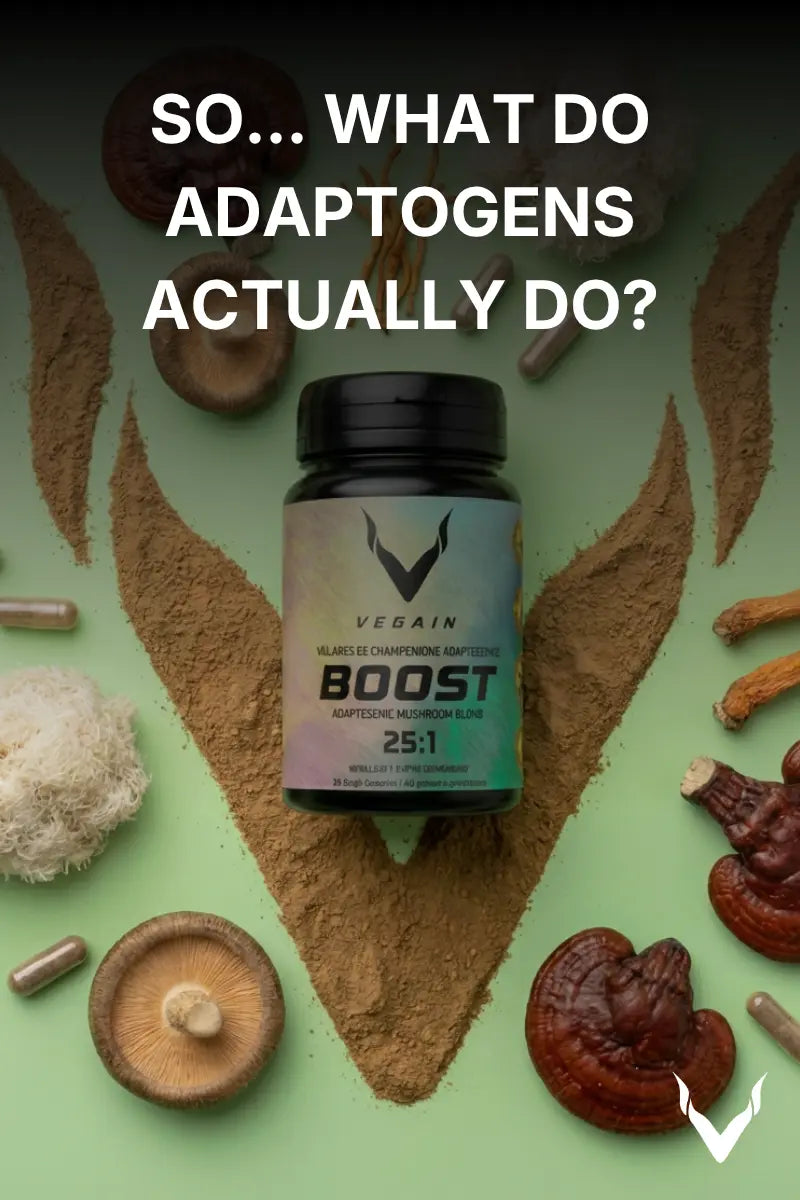
So What Do Adaptogens Actually Do?
"Adaptogen" shows up on a lot of labels these days, usually without much explanation. It's not one mushroom or one effect. It's a whole category, and BOOST alone uses five different ones. Here's what the word actually means, how they work, and why it takes more than a single dose to notice anything.
What Is an Adaptogen, Actually?
An adaptogen is a natural substance, usually an herb or mushroom, that helps the body handle stress and return to a state of balance. That's different from a stimulant like caffeine, which pushes you in one direction (up). An adaptogen is described as bidirectional: it can help your body compensate whether it's running too hot or too low, rather than just adding more energy on top.
How Do They Actually Work?
Most research points to adaptogens interacting with the hypothalamic pituitary adrenal (HPA) axis, the system that governs your stress response. In practice, that means they can help regulate cortisol, the main stress hormone, nudging it down when you're overly stressed and supporting it when it's chronically low. Some research also suggests adaptogens work at the cellular level, influencing how your cells metabolize things like blood sugar, and even how certain genes related to cellular stress get switched on or off. It's a system-wide balancing act, not a single mechanism.
Why You Might Not Notice an Effect on Day One
This is the part that trips people up. Adaptogens aren't built to hit like a shot of espresso. Since they work by gradually helping regulate a system (the HPA axis and its downstream effects) rather than flooding your body with one active compound, the effects tend to build with consistent use over days and weeks, not minutes. If you take BOOST once and don't feel an immediate shift, that's expected, not a sign it isn't working.
The 5 Mushrooms in BOOST
BOOST combines five adaptogenic mushrooms into a single 25:1 extract, each leaning toward a different job:
- Shiitake: generally associated with immune support and anti-inflammatory properties.
- Maitake: often studied for its role in glucose metabolism and energy.
- Reishi: has the deepest research base of the group, associated with better sleep and stress reduction.
- Lion's Mane: the one most tied to cognitive focus, memory, and mental clarity.
- Cordyceps: most associated with physical energy, endurance, and reduced fatigue.
Best Time to Take an Adaptogen
Some individual adaptogens do lean one way or another. Cordyceps and lion's mane are generally taken earlier in the day since they're associated with energy and focus, while reishi is often taken later since it leans calming. But since BOOST combines several of these into one capsule, splitting it up by time of day isn't really practical, and it isn't necessary either. What actually matters more than the exact hour is consistency: taking it around the same time each day, whatever time you'll actually stick with, since the effects build over repeated use rather than a single perfectly timed dose.
The Bottom Line
An adaptogen isn't a single ingredient with one job, it's a category of substances that help your body manage stress and find balance, working gradually rather than instantly. BOOST leans into that by combining five of them instead of betting on just one.
Five mushrooms, one capsule, built for the long game.






Laisser un commentaire
Ce site est protégé par hCaptcha, et la Politique de confidentialité et les Conditions de service de hCaptcha s’appliquent.